Flashback Trivia: Quiz Game
- 4.6
- Rating
- 100.00K
- Installs
- Free
- Price

 Analysis by App-foxy
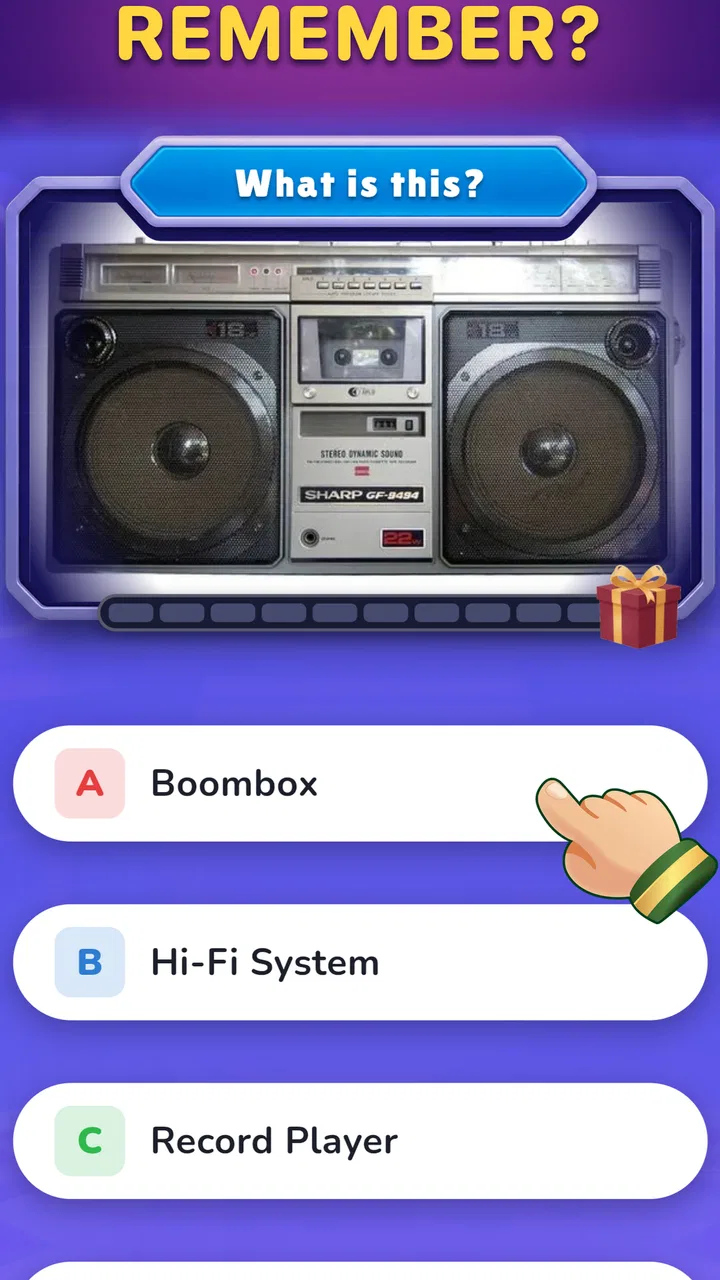
I enjoy trivia games most when they fit naturally into a spare moment instead of demanding a long session. Flashback Trivia: Quiz Game takes that approach with a pop-culture focus built around the 80s, 90s, and 2000s. I found the idea immediately approachable: choose an answer, trust your memory, and enjoy the small satisfaction of recognizing a song, show, film, celebrity, or cultural moment from another era.
That focus makes this a very different proposition from a broad general-knowledge quiz. It is less about proving how much you know across science, geography, and history, and more about testing the memories you collected from entertainment and everyday culture. In my experience, that gives each question a more personal feeling. Even a wrong answer can trigger a useful “I remember that now” moment.
The game is free to start, rated for Everyone, and comes from Lucky Echo Labs. It has reached over fifty thousand installs and holds a 4.6 average from around two thousand eight hundred ratings, which suggests that the central concept is connecting with a meaningful audience. I would still treat those figures as a sign of interest rather than a guarantee that every question will suit every player.
You May Also Like

 Blood Strike: 2.5 Anniversary
Blood Strike’s Loadouts Turn Every Drop Into a Tactical Gamble
A close look at Blood Strike’s custom loadouts: how fast access to signature weapons reshapes its battle royale rhythm, rewards preparation, and narrows the gap between fights.

 Pandora - Music & Podcasts
Pandora’s Music Is Easy to Start, but Harder to Recover
Pandora’s strength is its low-effort path from a seed to a station. Its weak spot is how much confidence it asks you to place in connection, setup, and quiet recovery.

 8 Ball Pool
 Is Built on Rivalries, Rematches, and Routine
A close look at the rivalries, rematches, shared routines, and unanswered safety questions that turn a quick pool match into a persistent mobile community.

 Samsung Music
’s Quiet Strength Is Playing What You Already Own
Its reach comes less from spectacle than from dependable access to a personal library. That simplicity is both the app’s strongest retention engine and its ceiling.

 AccuWeather: Weather Radar
AccuWeather Review: A Quick, Clear Forecast for Everyday Decisions
For everyday plans, the best forecast is the one you can understand quickly. AccuWeather makes rain timing, radar, and local conditions easy to act on, with a few trade-offs.

 Hill Climb Racing
Why Hill Climb Racing Still Turns Crashes Into One More Run
A tiny car, a bumpy hill and one more upgrade: Hill Climb Racing keeps resurfacing because its simple chaos makes every near-miss feel personal.
More From Our News Desk



How I would decide whether it belongs on your phone
I’d judge its place on your phone by whether you naturally return to those decades, rather than by how many questions you can finish in one sitting. I’d also notice whether a wrong answer sparks a memory or just feels like a guess; that difference is a useful test of whether the theme suits you. With that in mind, the next section looks at where this focused approach earns its keep—and when another style is a better fit.
The decade focus is the first question to ask
The most important decision is whether the selected eras match your interests. If you grew up with, or later became fascinated by, pop culture from the 80s through the 2000s, the theme gives the game a clear identity. It is easy to imagine playing it with a sibling, partner, or friend and discovering that one person remembers television while another dominates music or movie questions.
If you want a quiz that constantly changes subject, this narrower identity may feel limiting. A traditional general-knowledge game can move from capitals to biology to famous inventions in a single round. Flashback Trivia instead asks you to stay inside a particular cultural time capsule. That consistency is its strength when the subject feels familiar, but it is also the reason some players may tire of it sooner.
Think about the kind of challenge you actually enjoy
Pop-culture trivia rewards recognition, association, and memory more than careful deduction. I like that because it creates a relaxed challenge suitable for a coffee break or a short trip. You do not need to prepare, study, or remember complicated rules before starting. The multiple-choice format keeps the barrier low, while the wrong options can still make you question an answer you thought you knew.
There is a trade-off here. Multiple-choice questions can make a game feel accessible, but they can also reduce the satisfaction for players who prefer producing answers without prompts. When I already know an answer, selecting it feels quick and pleasant. When I only recognize two choices, the experience becomes more about elimination and instinct. That is entertaining, although it may not satisfy someone looking for a rigorous memory test.
Offline play changes the practical value
One of the most useful aspects is the ability to play offline. I see this as more than a convenience for people with unreliable reception. It makes the game suitable for flights, waiting rooms, commutes through poor-signal areas, or a quiet evening when you do not want to depend on a connection. A short quiz can be started without planning around network availability.
Offline access also changes how I would use it socially. I could hand the phone to someone during a family gathering or keep it available for a quick round while travelling. The game does not need to become the centre of the occasion; it can work as a conversation starter. A question about an old band or television program can lead to a story even when nobody agrees on the answer.
Version and device considerations
The current release is version 1.0.41, and the minimum requirement is Android 7.0. That makes it accessible to many older Android devices, which matters if you keep a spare phone or do not upgrade regularly. I would still judge the experience on the device you intend to use, because an older operating system does not automatically tell me how comfortable the controls or text will feel on every screen.
The age rating of Everyone is another reason the game can fit shared use. Parents may appreciate a quiz that can be introduced without selecting an older audience category, while adults can enjoy the nostalgia on their own. The rating does not mean every question will appeal equally to all ages; it simply makes the overall presentation easier to consider for a broad household.
Three practical ways I would use it
My first use would be a short personal reset. Instead of opening a social feed during a five-minute break, I would play a few questions and stop when the break ends. The decade-based theme gives the session a natural boundary, and the offline capability means I would not need to wait for a connection or manage a separate setup.
My second use would be a family memory test. I would ask one person to answer without help, then let everyone discuss the choices before confirming the result. This works particularly well when the group has different age backgrounds. Someone who was young during the 2000s may recognize a reference that an older relative misses, while the reverse may happen with an 80s question.
My third use would be a themed evening. Rather than treating the game as a complete party package, I would use it between music, films, or television episodes from the same period. The quiz becomes a lightweight way to keep the theme active. That is a more realistic role for it than expecting one app to provide an entire social event.
Where Flashback Trivia feels strongest, and where another style may suit you better
For me, the strongest case for keeping it is having an easy, offline option for a spare moment or a shared nostalgia break, without expecting it to replace every kind of quiz. The key trade-off is whether familiar entertainment references stay enjoyable after the first burst of recognition. I’ll weigh that recurring appeal against the broader variety and different kinds of challenge other games can offer.
Its strongest advantage is emotional recognition
The game has a clear advantage over a generic quiz when the player wants nostalgia rather than academic variety. A question connected to a familiar decade can feel warmer than a random fact. I often remember where I encountered a song, show, or celebrity before I remember the exact detail being asked. That personal connection gives the answer more weight than a detached fact from a general quiz.
This also makes it a good choice for mixed-ability groups. In a difficult general-knowledge game, one person may dominate because of education or specialist interests. A pop-culture quiz spreads opportunities more widely. One player may know music, another movies, and another television. The result can feel more conversational and less like an exam, especially when nobody treats the score too seriously.
The short-session design is easy to live with
I would recommend it to people who want a game they can open without learning a complicated progression system. The multiple-choice structure communicates what to do immediately. That matters on a phone, where friction can make a supposedly casual game feel like work. Flashback Trivia is most appealing when you want a quick mental diversion, not a hobby that requires a schedule.
There is also value in having a focused theme rather than a huge menu of modes. A broad quiz app can offer more variety, but that variety can dilute its personality. Here, I know roughly what kind of mood I am choosing. If I am in the mood for cultural memories from the three featured decades, the game is easier to pick than an app that asks me to configure several categories first.
Where a general trivia alternative may be better
I would choose a broader trivia game for study, family groups with very different interests, or anyone who wants a constant rotation of subjects. Geography fans, science enthusiasts, and history players may find more lasting value in an alternative built around those fields. Flashback Trivia can still be enjoyable for them, but its appeal depends on being willing to meet the game on its pop-culture ground.
I would also look elsewhere if competitive depth is the main goal. Players who want elaborate leaderboards, live matches, detailed statistics, or a large strategic progression should compare it with games designed around those priorities. I am not saying this title cannot be fun for competition; I am saying its strongest reason to install it is the themed question experience, not an expectation of a full esports-style structure.
Where a puzzle or word game may fit better
Some players want to reason through clues rather than identify cultural references. For them, a crossword, word puzzle, or logic game may provide a more satisfying daily challenge. Those formats usually reward constructing an answer from information on the screen, whereas Flashback Trivia depends more heavily on what you already remember or recognize.
The distinction is useful when choosing a game for someone else. I would give this to a friend who enjoys saying, “I know that one,” or who likes comparing memories with other people. I would not automatically recommend it to a friend who avoids entertainment trivia and prefers abstract puzzles. The free price makes trying it easy, but the theme still determines whether it will stay installed.
What the free model means in practice
There is no purchase price to begin playing, which lowers the risk of testing the concept. In-app purchases range from sixty-nine cents to $19.99 per item. Because of that range, I would approach the game with a simple personal rule: start free, learn what the normal session feels like, and decide later whether any optional purchase genuinely improves your use.
I would not install it expecting every part of the experience to be permanently free or assuming that a purchase is necessary. The sensible approach is to treat the free entry as a trial of the questions, pacing, and overall fit. If the core nostalgia does not appeal to you, spending money will not solve that mismatch. If you enjoy the game, you can make a more informed decision after using it naturally.
The cost of switching is low, but attention is not
Moving from another quiz app to this one is easy in one sense: there is no new subject to study and no complicated skill to develop. You can simply install it, answer a few questions, and see whether the decade focus works for you. That makes it a low-commitment experiment compared with games that ask you to build a long-term profile or learn elaborate systems.
The real cost is attention. Every trivia game competes with other quick distractions, and a focused theme can either make this one memorable or make it feel repetitive. I would give it several sessions across different days rather than judging it after a single lucky run. A game that feels charming during a nostalgic mood may feel less appealing when you want fresh subject matter.
For people changing phones or sharing devices, I would also keep expectations practical. The important question is whether the game is available and comfortable on the device you use, not whether it replaces every other quiz app. I see it as a specialist addition: a compact pop-culture option that earns space when its theme matches your habits.
Small habits that make the experience better
I found that answering too quickly can reduce the fun. When two choices look familiar, I would pause and explain my reasoning before selecting one. That turns a simple tap into a memory exercise and works especially well when playing with another person. The pause also makes wrong answers feel less random because you can identify which clue led you astray.
A second useful habit is to treat mistakes as prompts for conversation rather than failures. If a question exposes a gap in my memory, I would note the subject mentally and see whether someone else remembers it. This is particularly effective with decade-based material, where the same reference may be obvious to one generation and completely unfamiliar to another.
Finally, I would use offline play deliberately instead of only appreciating it as a backup. Download or open the game before leaving a reliable connection, then keep it ready for a journey or waiting period. That workflow turns the feature into a dependable part of the routine. It is a small distinction, but it is the kind of practical advantage that a short store description cannot show.
My recommendation depends on your reason for playing
I recommend Flashback Trivia: Quiz Game to anyone who wants accessible, nostalgia-led entertainment in short sessions. It is especially suitable for friends and relatives who enjoy comparing memories, for adults drawn to the 80s through 2000s, and for travellers who value offline play. The free starting point and Everyone rating make it easy to try without turning the decision into a major commitment.
I would skip it if you mainly want current events, school-style learning, deep subject coverage, or a highly competitive online structure. In those situations, a broad trivia app, a dedicated educational quiz, or a more feature-heavy multiplayer game will probably serve you better. The focused theme is not a weakness by itself, but it becomes one when it does not match what you want to think about.
Overall, I see this game as a friendly specialist rather than an all-purpose trivia replacement. Lucky Echo Labs has chosen a recognizable lane, and that lane gives the experience its charm. The combination of multiple-choice play, three familiar cultural eras, offline access, and a free entry point makes it easy to recommend as a casual download. The best reason to keep it is not the promise of endless variety, but the way a simple question can bring an old memory back to the surface.
FAQs for Flashback Trivia: Quiz Game
01What is Flashback Trivia: Quiz Game?
Flashback Trivia: Quiz Game is a quiz app focused on testing your knowledge across a variety of subjects, with questions designed to bring back memorable facts, events, and moments from different eras. It is suitable for casual players who want a quick challenge, as well as trivia fans looking to improve their scores through repeated play.
02How does the gameplay work in Flashback Trivia: Quiz Game?
Gameplay generally consists of answering multiple-choice trivia questions within a quiz session. You select the answer you believe is correct and receive feedback before continuing to the next question. Depending on the available mode and device version, the app may include scoring, timed challenges, progress tracking, or different categories that help keep each round varied.
03Is Flashback Trivia: Quiz Game suitable for beginners and families?
Yes, the app is easy to understand because its core gameplay relies on reading a question and choosing an answer. However, the difficulty can vary considerably between categories and rounds. Younger players may need help with questions about older events, culture, or history, while adults and experienced trivia players may find some sessions more challenging and rewarding.
04Does Flashback Trivia: Quiz Game require an internet connection?
The connection requirements can depend on the version of the app and the features being used. Basic question gameplay may work in some situations without a constant connection, but online features, advertisements, updates, leaderboards, cloud-related services, or newly delivered content may require internet access. It is best to check the app-store listing before downloading if offline play is important to you.
05Is Flashback Trivia: Quiz Game free to download and does it contain ads or purchases?
Flashback Trivia: Quiz Game may be available as a free download, but free access does not always mean that every feature is completely unrestricted. Many quiz apps use advertising, optional in-app purchases, or paid upgrades to support development and unlock additional content. Review the current Google Play or App Store listing for the latest pricing, advertising details, and purchase information before installing.
Pros
- Wide range of trivia categories keeps each session varied.
- Quick rounds make it easy to play during short breaks.
- Simple controls are accessible for most players.
- Helpful feedback lets you learn from incorrect answers.
- Competitive scoring adds motivation for replaying quizzes.
Cons
- Some questions may feel too easy for experienced trivia fans.
- Difficulty can vary noticeably between categories.
- Repeated questions may appear after extended play.
- Progress may feel limited without more advanced challenges.
- An internet connection may be required for some features.

Flashback Trivia: Quiz Game
Gallery